
Hans Leo Hassler (1564–1612): Missa secunda
Hans Leo Hassler (1562–1612) was a prominent composer and organist of the late Renaissance. He was born into a musical family in Nuremberg. Both his father, Isaak, and his two brothers, Kaspar and Jakob, were musicians, organists and composers. In this era, vocal music still had the greatest musical significance; purely instrumental music was virtually non-existent, and instruments were always played alongside singing voices.
Hassler’s career was greatly influenced by his connections to the Fugger family, by whom he was employed, as well as to local princes and wealthy citizens. Later, he also had a loose connection to Emperor Rudolf II, who elevated Hans Leo Hassler and his two brothers to the nobility. The most important stages of his life included Nuremberg (employment with the Fuggers), Venice (student of Andrea Gabrieli), Augsburg, Ulm and, once again, Nuremberg. In 1608, Hassler moved to Dresden, where he died of consumption (tuberculosis) soon after the coronation of Emperor Matthias in Frankfurt.
In addition to his work as a musician, Hassler was also highly regarded as a craftsman, particularly in the field of mechanical musical instruments. He was a contemporary of Orlando di Lasso and Michael Praetorius. His studies with Andrea Gabrieli in Venice were particularly formative, where he absorbed important Italian and early Baroque influences.
The ‘Missa secunda’, which appeared in 1599 in an early music print alongside other masses, is stylistically very much rooted in the ideals of Renaissance music and draws particularly on the tradition of Orlando di Lasso. The mass is characterised by a striking contrast between homophonic and polyphonic sections. Its form appears very concise overall, and its duration is accordingly short. Despite its brevity, the entire Mass text is fully set to music. In the Credo in particular, a homophonic compositional technique is frequently employed to ensure the text is clearly articulated. Following liturgical rules, the Mass is performed without the Gloria during Advent and Lent.
Sebastian Bürger, Wien Mai 2026
Conductor: Stefan Foidl
Organ: Elke Eckerstorfer
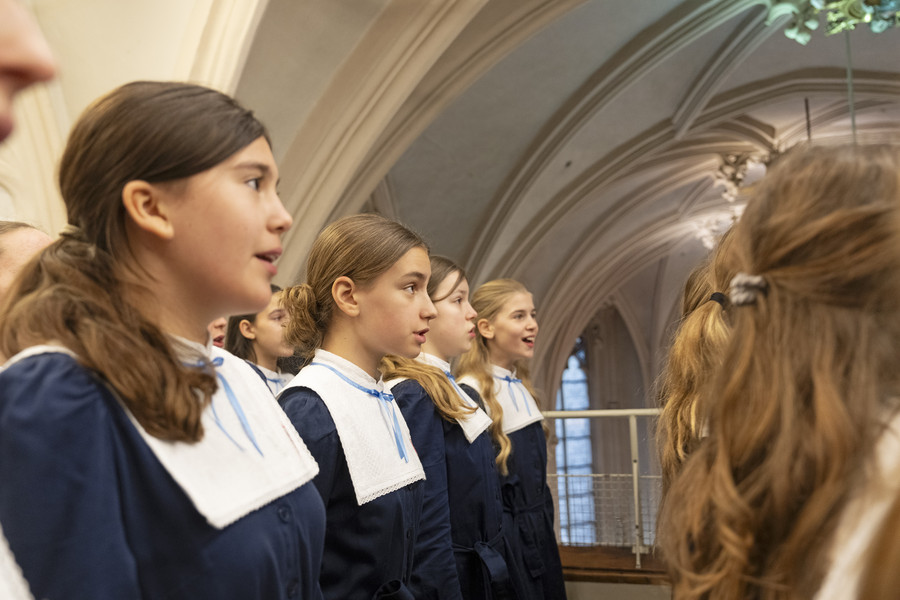
Choir: Vienna Girls Choir, members of the Vienna State Opera men's choir and “Choralschola der Wiener Hofburgkapelle”
Celebrant: Peter Schipka
Duration: approx. 110 min. (09:15-11:05)
Ticket reservation at office@hofmusikkapelle.gv.at
Online ticket sale through Culturall: