
Michael Haydn (1737–1806): Mass in G major, Sub titulo Sancti Leopoldi pro Festo sanctorum innocentium
Like his elder brother Joseph, Michael Haydn began his musical career as a choirboy at St Stephen’s Cathedral. In 1763, after a few years’ service as a choirmaster at the prince-bishop’s court in Großwardein, his path led him to Salzburg, where he was active as a composer until his death in 1806. He served under three rulers there: first Prince-Archbishop Count von Schrattenbach, then Count Colloredo from 1771, followed by Ferdinand III (brother of Emperor Franz I/II) after the abolition of church rule and the transfer of Salzburg to a Habsburg duchy in 1802/3.
Michael Haydn left behind numerous instrumental works, stage music, oratorios and songs. However, his church music was of greatest significance. This body of work also includes a series of pieces composed specifically for boys’ choirs. There is no doubt that these works were intended for the boys in Salzburg, to whom he felt a particular affinity due to his own time as a choirboy at St Stephen’s. Two masses and a series of sacred songs for boys’ voices have survived. In addition to the ‘Missa Sancti Leopoldi’, he also composed the ‘Missa Sancti Aloysii’ (as early as 1777). Both works found their way into the repertoire of the Vienna Court Music Ensemble just a few years after his death, where they are still performed today. It is also worth noting that on 28 December (a day still known today as ‘the Feast of the Holy Innocents’, in remembrance of the massacre of the infants in Bethlehem), a corresponding celebration was held at the Salzburg court in honour of the choirboys.
The ‘Missa Sancti Leopoldi’ was composed specifically for such an occasion. The mass features two soprano parts and one alto part, each of which also performs as a solo. The orchestra consists of a three-part string section with violins and basses, an organ and two horns. This is also a distinctive feature, as horns were rather a rarity in contemporary church music, yet here they play a very prominent role, even though the score designates them as ‘non obligati’. The organ also features as a solo instrument in the Benedictus.
Sebastian Bürger, July 2026
Conductor: Jordi Casals
Organist: Wolfgang Kogert
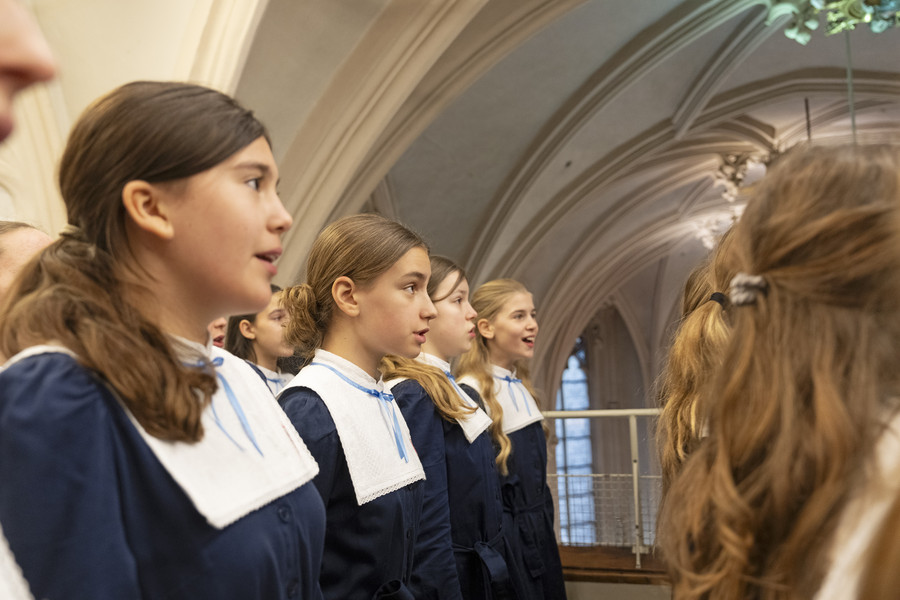
Choir: Vienna Girls Choir, "Choralschola der Wiener Hofburgkapelle"
Orchestra: Members of the Vienna State Opera Orchestra
Celebrant: Peter Schipka
Duration: approx. 85 min (09:15-10:40)
Ticket reservation at office@hofmusikkapelle.gv.at
Online ticket sale through Culturall: