
Claudio Monteverdi (1567–1643): Messa a quattro voci da capella (1650)
Claudio Monteverdi was baptised on 15 May 1567 in Cremona and was the son of a doctor and apothecary who was a prominent member of the local community. From an early age, he received a thorough education in singing, violin and composition from Marc Antonio Ingegneri, the choirmaster at Cremona Cathedral. By the age of 15, he was already composing his first works, which were published as early as 1583 under the title ‘Madrigali spirituali Canzonette a tre voci’. His life soon shifted from Cremona to Mantua, where he was employed in the court chapel of Duke Vincenzo I Gonzaga starting in 1590. Here he developed into one of the most famous composers and musicians of his time and composed countless works. In 1612 he moved from Mantua to Venice, partly due to irregular salary payments. Here he was no less productive as choirmaster at St Mark’s Basilica until his death in 1643.
The compositional style known as ‘seconda prattica’, which he largely shaped, is regarded as particularly innovative and represents a turning point in the history of music. This new style can be summarised as the deliberate transgression of the traditional rules of polyphonic composition (the ‘prima prattica’), in ways that correspond to the text.
Only a handful of Monteverdi’s masses have survived. The ‘Messa 4 voci da Cappella’ was not published until 1651 in a collected edition. An exact date of composition is not known. The original instrumentation called for one soprano part, two alto parts and a combined tenor and bass part. In modern performance practice, however, the second, lower alto part is sung by the tenor and the bass part is sung only by the basses.
Although Monteverdi’s name is inextricably linked with the ‘seconda prattica’ (and, it should be noted, with the birth of the madrigal, opera and oratorio), his masses are works in the style of the ‘prima prattica’ – that is to say, polyphonic works in which each voice has an independent line and the structure arises from the blending of the lines.
Vienna, June 2026, Sebastian Bürger
Conductor: Manuel Huber
Organist: Jeremy Joseph
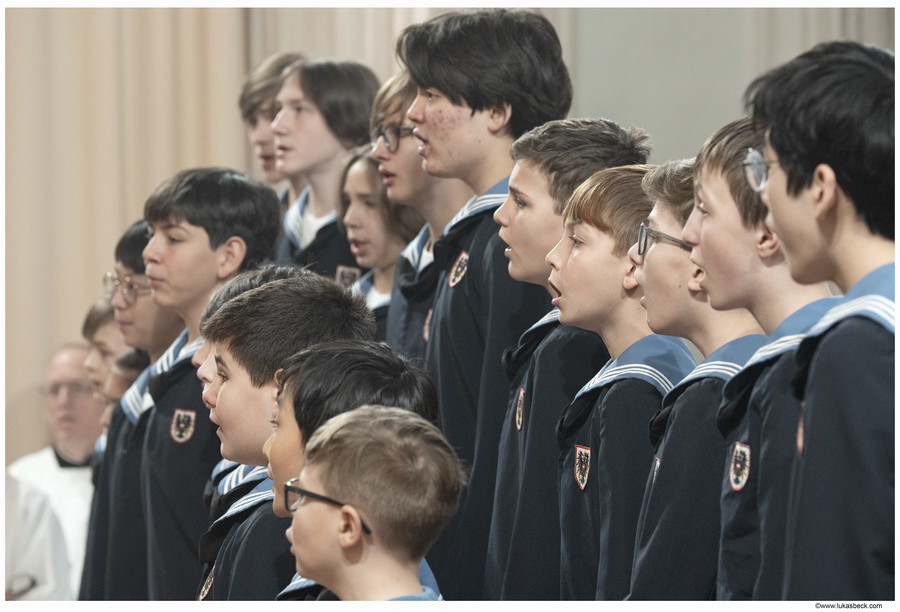
Choir: Vienna Boys Choir, Vienna State Opera men's choir, “Choralschola der Wiener Hofburgkapelle”
Celebrant: Peter Schipka
Duration: approx. 80 min (09:10-10:35)
Ticket reservation at office@hofmusikkapelle.gv.at
Online ticket sale through Culturall: